> For the complete documentation index, see [llms.txt](https://docs.insilicoterminal.com/documentation/llms.txt). Markdown versions of documentation pages are available by appending `.md` to page URLs; this page is available as [Markdown](https://docs.insilicoterminal.com/documentation/application-elements/performance.md).
# Performance
Trade with a massively improved performance boost during those high octane news events. Smooth UI updates, no lag, no freezing. Terminal 5.0 is optimized to handle huge amounts of volatile market data
{% hint style="info" %}
We advise not to run the Terminal in multiple browser tabs simultaneously, as this will degrade performance. Please use the Terminal's internal tab system!
{% endhint %}
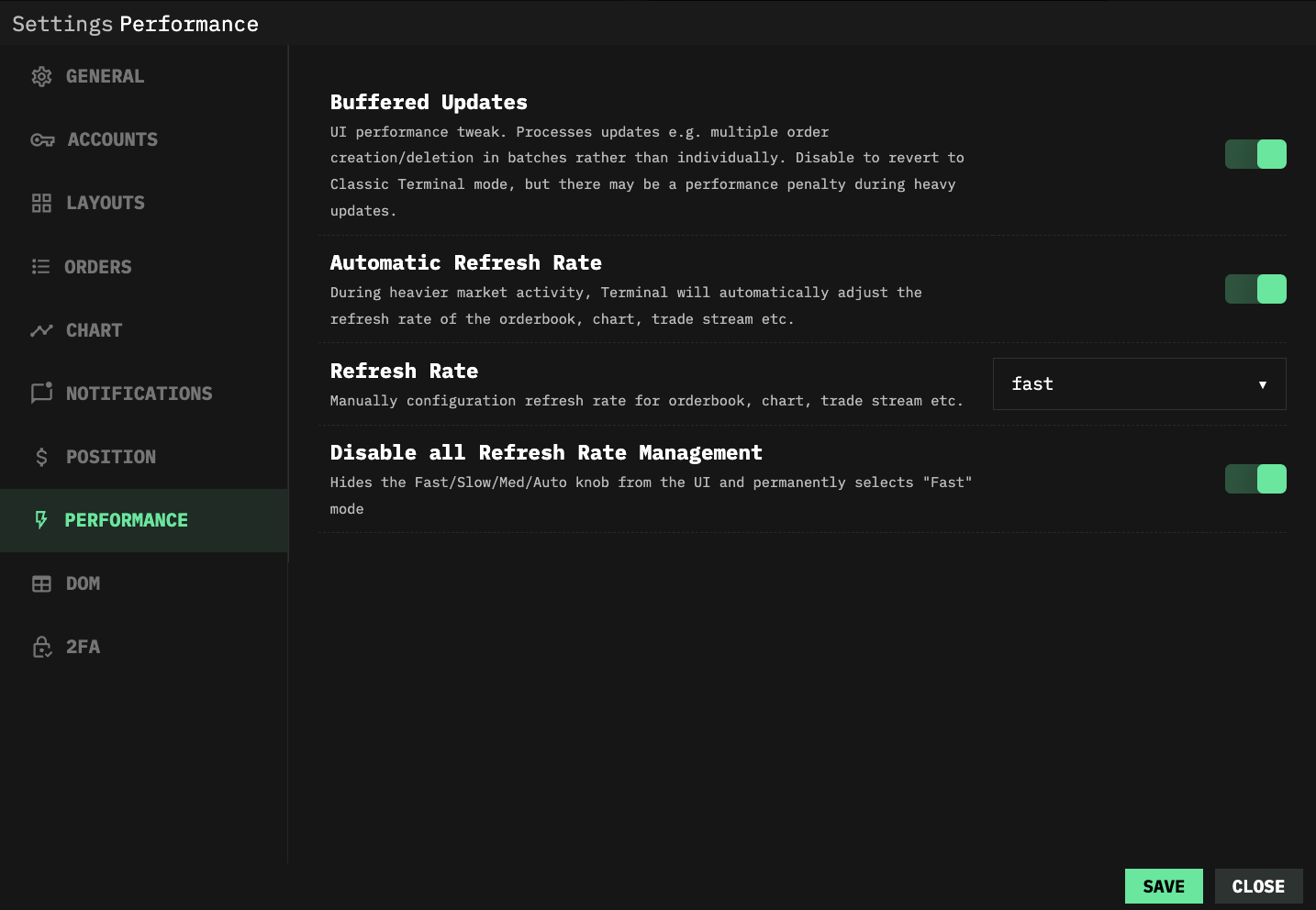
The Terminal comes with our recommended performance settings by default. If you want to adjust those yourself, please head to the Performance tab in the Settings menu.
### Buffered Updates
When enabled, this settings will process updates on your orders, positions etc in batches rather than individually. This can give a tremendous performance boost when cancelling / creating large numbers of orders e.g. during a Scale or Swarm. On by default.
### Automatic Refresh Rate
The Terminal will switch between Slow, Medium and Fast automatically when it detects increased market activity. On by default
### Refresh Rate
If you are operating on a slower machine, you can manually adjust the base refresh rate. Fast by default.
### Disable all Refresh Rate Management
By enabling the Refresh Rate Management a performance dial will appear in the header menu. If you want full control or things get *really* heavy you can modify the UI refresh rate quickly and manually by adjusting the dial. Disabled by default.